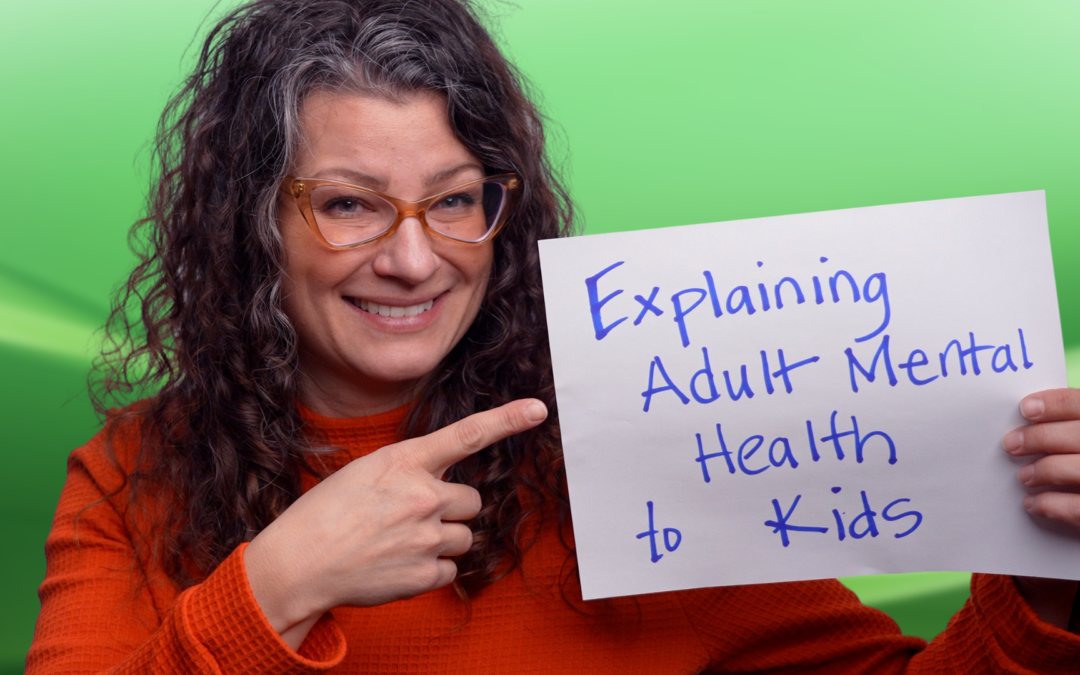
Many parents know they should talk to their kids about adult mental health, but when adult mental health hits close to home or becomes a personal issue, starting that conversation can feel overwhelming.
I’ve heard parents say things like, “I don’t want to make it worse, so I didn’t say anything,” or “I just told them Grandma was on vacation because I didn’t know what was appropriate.” But here’s the truth: Silence doesn’t always protect kids. More often than not it confuses them.
Without clear and developmentally appropriate explanations, children start filling in the gaps with their own narratives coming up with a “private logic” that can be anything but logical about what is going on such as “This must be my fault,” “Something bad is going to happen,” or “I shouldn’t talk about this.”
I’m Susan Stutzman, a Licensed Clinical Professional Counselor and owner of Kid Matters Counseling. I’ve spent years working with children and families navigating mental health challenges, and I’ve seen firsthand what can help, as well as what doesn’t help, kids and families process difficult topics.
The good news? It is absolutely possible to talk to kids about adult mental health in a way that builds trust, emotional safety, and resilience. You don’t need perfect words, but you do need a plan.
Here, I’ll walk you through four simple steps you can use today to have these conversations with confidence. Whether you’re talking to a preschooler or a teenager.
1. Plan, Don’t Wing the Conversation Moments
Timing matters. Choose a moment when your child is not overly stressed, not rushed, exhausted, or already upset. Quiet times like a walk, a car ride, or relaxed play (like painting or using a fidget toy) can feel less intimidating than a formal sit-down talk.
A calm environment helps your child’s nervous system stay open to listening and understanding.
2. Match the Conversation to Your Child’s Age & Development
Children don’t need adult explanations. They need developmentally appropriate ones.
For young children (preschool age): Use simple language focused on observable feelings, such as “Sometimes [grandma’s] brain feels tired or sad, and [I’m] getting help to feel better. I’m not sad about you, and all feelings are not forever.”
For school-age children: They can understand that mental health is similar to physical health. So try saying something like “Just like people get help for asthma or diabetes, people can get help when their feelings feel too big. There are many ways to get help and [I’m] talking to special doctors and counselors, changing my diet, and adding in exercise to help me help my feelings. This takes some extra time and I might look more tired or have less energy to play, but I still love you!”
For teenagers: They often already have information. And, while some may be accurate, some are not. So, still have a conversation where you share what’s going on, invite questions, listen without overcorrecting, and be honest while maintaining boundaries.
The goal isn’t to share every detail. The goal is clarity without overwhelm.
I have some great book recommendations on this topic and more under Parent Resources. Explaining specific mental health conditions in adults to kids can be tricky, so having an example in a book can be a helpful jumping off point.
3. Offer Reassurance, Again & Again
Every child needs to hear these core messages clearly:
This is not your fault.
You are safe.
It’s not your job to fix this; adults are handling this.
Remember, children may ask the same questions repeatedly. This isn’t because they weren’t listening. It’s because reassurance helps regulate their nervous system.
Repetition builds safety. Regulation leads to relating that leads to reasoning skills.
Pay close attention to your child’s reactions. Sometimes their biggest questions are expressed through behavior, not words.
4. Keep the Door Open for Ongoing Conversations
This doesn’t have to be one big talk. In fact, it’s better if it isn’t. Let your child know they can come back with questions anytime by saying something like, “If you ever wonder about this or feel worried, you can always talk to me about this again.”
Ongoing conversations teach children that mental health isn’t a taboo topic, but that it’s a part of being human.
And, if you’re feeling nervous about having this conversation, that doesn’t mean you’re doing it wrong. It means you love your child and want to protect them, but you may just need a bit of support.
Start small. Use simple language. Focus on reassurance more than explanation.
Honest, compassionate conversations create safety, connection, and healing, and those are the foundations every child needs to thrive.
And, if you’d like support navigating these conversations, don’t hesitate to schedule an appointment at Kid Matters, where we help parents and children navigate all types of Matters. We’re here to help.

Susan Stutzman
Owner | Child Therapist | LCPC, RPT
Parenting is hard! But you don’t have to do it alone. I work with children and parents to resolve emotional conflict, cultivate healing, and nurture hope.




New Clients Call: (855) 586-1802
Current Clients: (855) 543-7687
Ask Us Anything!

We help anxious kids and frustrated parents. We serve Hinsdale & the Western Suburbs of Chicago.
Made with ♥︎ in Hinsdale, Illinois for Chicago
Built By Brand Your Practice.
Kid Matters Counseling, P.C. DISCLAIMER: This website and blog are for informational, educational and general discussion purposes only. It is understood that no guarantee or warranty arises from the information provided, discussed or commented upon in this website and blog nor does it constitute legal or other professional advice on any subject matter. Access to this website and blog is voluntary and at the sole risk of the user. If you think that you have a medical emergency (including clinical), call your doctor or 911 immediately. A licensed medical professional should be consulted for diagnosis and treatment of any and all medical conditions. While the information contained within this website and blog is periodically updated, no guarantee is given that the information provided is correct, complete, and/or up-to-date. See our complete Privacy Policy and Terms of Service.